
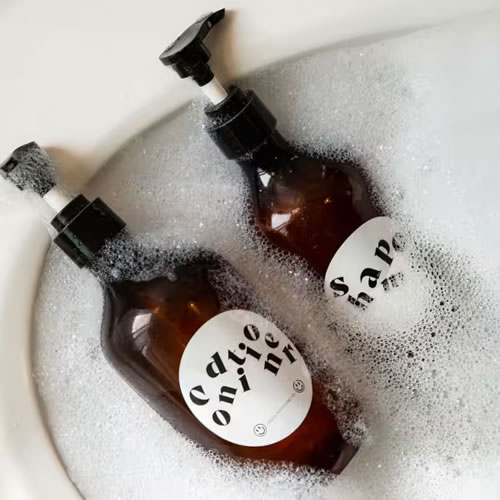
Labels are exposed to much more than ink and adhesive. Depending on the application, a label may come into contact with water, condensation, oil, chemicals, sunlight, temperature changes, and frequent handling.
For products used in these conditions, choosing the right waterproof label material is essential. A label may have an excellent design, but if the material absorbs moisture, the printing fades, or the adhesive loses its grip, the label can quickly become damaged.
This is why waterproof label materials are widely used for food and beverage packaging, cosmetics, chemical containers, outdoor products, industrial equipment, and other demanding applications.
In this guide, we will look at the most common waterproof label materials, their advantages, and how to select the right option for different applications.
A waterproof label is not determined by the face material alone. Its overall water resistance depends on several components working together.
The main factors include:
Face material: Determines how well the label itself resists water and moisture.
Printing method and ink: A waterproof substrate can still fail if the printed information is not resistant to moisture or abrasion.
Adhesive: The adhesive must maintain sufficient bonding strength when exposed to water or humidity.
Surface finish: Laminates, coatings, and other finishing options can provide additional protection.
Application environment: Temperature, UV exposure, chemicals, condensation, and mechanical friction can all affect label performance.
Therefore, selecting a waterproof label should be treated as a complete material-and-printing solution rather than simply choosing a “waterproof” substrate.
Different waterproof label materials offer different levels of durability, flexibility, chemical resistance, and cost. The most suitable choice depends on the product and its actual operating environment.
PET, or polyethylene terephthalate, is one of the most durable materials used for waterproof labels.
PET labels offer excellent resistance to:
Water and moisture
Tearing
Abrasion
Chemicals
Temperature changes
UV exposure, depending on the specific construction
Because of their strength and dimensional stability, PET labels are often used for industrial products, electronics, electrical equipment, chemical containers, outdoor applications, and products requiring long-term identification.
PET is particularly suitable when label durability is more important than flexibility or low cost.
Polypropylene (PP) is another popular material for waterproof labels.
PP labels provide good resistance to water and moisture while maintaining a relatively flexible structure. They are commonly used in packaging applications where the label needs to withstand refrigeration, condensation, or occasional contact with water.
Typical applications include:
Food and beverage packaging
Cosmetic packaging
Personal care products
Household products
Bottles and containers
PP can also provide a smooth printing surface, making it suitable for high-quality product labels.
PVC is known for its flexibility, durability, and resistance to moisture.
PVC labels can conform well to curved surfaces, making them suitable for bottles, containers, equipment, and products with irregular shapes.
Depending on the formulation and construction, PVC labels can provide good resistance to:
Water
Humidity
Outdoor exposure
Abrasion
Certain chemicals
However, the environmental requirements of the product should be considered when selecting PVC, especially for applications where material composition and recycling requirements are important.
Synthetic paper is designed to provide the appearance and printability of traditional paper while offering much better resistance to water and tearing.
It is often used when a product requires a paper-like appearance but also needs improved durability.
Synthetic paper labels can be suitable for:
Food packaging
Beverage labels
Logistics labels
Product identification
Retail packaging
For applications where appearance and moisture resistance are both important, synthetic paper can be an effective alternative to conventional paper labels.
There is no single waterproof material that is ideal for every application.
When selecting a material, consider the following factors.
Occasional splashes are very different from continuous exposure to water.
For example, a beverage bottle may experience condensation and refrigeration, while an outdoor equipment label may be exposed to rain for extended periods.
The expected level of moisture exposure should therefore be considered before selecting the material.
Chemical products may require more than basic waterproofing.
If a label is used on cleaning products, industrial chemicals, oils, or other aggressive substances, both the face material and printing system should be evaluated for chemical resistance.
Outdoor labels typically need to withstand more than water.
UV radiation, temperature fluctuations, rain, dust, and abrasion can gradually damage labels.
For these applications, a suitable combination of UV-resistant printing, durable face material, and appropriate adhesive can significantly improve service life.
The container or product surface is also important.
Glass, plastic, metal, cardboard, and painted surfaces can have very different adhesion characteristics.
Curved or textured surfaces may require a more flexible label material and an adhesive specifically selected for the application.
A waterproof face material does not automatically make the entire label waterproof.
The adhesive is equally important.
When exposed to moisture, an unsuitable adhesive may lose adhesion, lift around the edges, or completely detach from the product.
For demanding applications, the adhesive should be evaluated according to:
Surface type
Temperature
Humidity
Water exposure
Application conditions
Expected service life
For example, labels applied to refrigerated beverage containers may require an adhesive that performs well under condensation and low-temperature conditions.
This is why professional label production should consider the material, adhesive, printing, and application environment as a complete system.
Even when the substrate and adhesive are suitable, the printing must also withstand the intended environment.
Depending on the application, manufacturers may use printing systems and protective finishes designed to improve resistance to:
Water
UV exposure
Scratching
Friction
Chemicals
A protective laminate or coating can provide an additional barrier against moisture and abrasion.
For outdoor or long-term applications, UV-resistant inks and protective finishing can help reduce fading and maintain the readability of important information.
For industrial labels, this is particularly important because faded or damaged identification information can affect product tracking, safety, and maintenance.
Waterproof labels are used across many industries.
Bottles, cans, jars, refrigerated products, and other food and beverage containers may be exposed to condensation, ice, water, and temperature changes.
Waterproof or moisture-resistant labels help maintain product information and brand presentation throughout the product's service life.
Shampoo bottles, skincare containers, body wash bottles, and other bathroom products are frequently exposed to water.
PP, PET, and other synthetic materials are commonly considered for these applications.
Chemical containers require labels that remain readable and securely attached under demanding conditions.
Depending on the chemical and environment, additional requirements such as chemical resistance, abrasion resistance, and GHS compliance may also need to be considered.
Labels used outdoors may face rain, sunlight, temperature changes, and physical abrasion.
For these applications, waterproofing should usually be combined with UV resistance and a suitable outdoor-grade adhesive.
Equipment identification labels, warning labels, asset labels, and nameplates may need to remain readable for years.
PET and other durable synthetic materials are often suitable for these applications when long-term performance is required.
The terms “waterproof” and “water-resistant” are sometimes used interchangeably, but they can describe different levels of protection.
Water-resistant labels are generally designed to tolerate limited exposure to moisture, splashes, or humidity.
Waterproof labels are designed for applications where significantly greater exposure to water is expected.
However, the actual performance depends on the complete label construction and testing conditions.
For this reason, it is better to define the real application requirements rather than selecting a material based solely on the word “waterproof.”
For example:
Occasional splash → water-resistant construction may be sufficient.
Refrigerated bottle with condensation → moisture-resistant material and adhesive are important.
Outdoor equipment → waterproof + UV-resistant construction may be required.
Industrial chemical container → waterproof + chemical-resistant construction may be necessary.
Selecting a waterproof substrate is only the first step.
To achieve long-lasting label performance, consider the following:
1. Match the material to the application.
Different products require different levels of water, chemical, UV, and abrasion resistance.
2. Select the appropriate adhesive.
The adhesive should match both the product surface and environmental conditions.
3. Use suitable printing technology.
The printing system should be compatible with the material and required durability.
4. Consider protective finishing.
Lamination or coating may provide additional protection for demanding applications.
5. Test the complete label construction.
Whenever possible, test the finished label under actual or simulated operating conditions before large-scale production.
Choosing the right waterproof label material is essential when labels need to remain attractive, readable, and securely attached under demanding conditions.
PET, PP, PVC, and synthetic paper each offer different advantages. However, the best solution is not determined by the face material alone. Adhesive selection, printing technology, protective finishing, and the actual application environment all play an important role in determining long-term label performance.
For companies looking for custom waterproof labels, working with an experienced label manufacturer can make the material-selection process much easier. A professional manufacturer can evaluate the product surface, environmental conditions, required service life, printing requirements, and budget before recommending the appropriate label construction.
There is no universal best material. PET is often preferred for applications requiring high durability, while PP offers a good balance of flexibility, moisture resistance, and printability. Synthetic paper can be suitable when a paper-like appearance is desired.
Standard paper labels generally have limited resistance to water and moisture. If a paper-like appearance is required together with better water resistance, synthetic paper or a suitable protective coating may be considered.
PET itself has excellent resistance to water and moisture. However, the overall waterproof performance of a PET label also depends on the adhesive, printing system, and finishing.
Outdoor labels generally require a combination of durable face material, weather-resistant adhesive, UV-resistant printing, and appropriate protective finishing.
Yes. Waterproof labels can be customized in terms of material, size, shape, adhesive, printing, surface finish, and other specifications according to the product and application requirements.
Reach out to us anytime at zdlabel@hotmail.com to discuss your specific needs.